
Welcome to Donald Kentner's Instructional Design Portfolio
My work spans Training & Development, Instructional Design, & Technical Instruction, with one goal: equip learners to perform with confidence. In this portfolio, you’ll find scenario‑based modules, technical training solutions, and evidence‑driven designs that demonstrate how I approach learning challenges with purpose
ARTICULATE STORYLINE 360
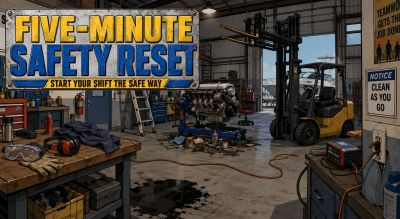
the five-minute safety reset
This interactive safety project guides learners through identifying workplace hazards, understanding their real‑world severity, and making informed corrective decisions. Learners practice ranking risks using national BLS injury and fatality data to ground their choices in real incident trends. Scenario‑based decision points reinforce when to fix hazards and how to avoid unsafe behaviors. A safety‑reset helps learners build practical habits they can apply immediately on the job. The final reflection summarizes safe actions, risky choices, and overall performance to strengthen long‑term safety awareness.
Try the Storyline scenario by clicking the button below:
problem statement
The shop’s three technicians begin work immediately each morning without assessing the environment. Because the shop is cluttered, poorly maintained, and filled with mixed equipment (farm machinery, marine engines, moving trucks), hazards accumulate daily: trip hazards, crush risks, chemical spills, unsecured tools, and PPE inconsistencies.
The owner reports:
- minor injuries
- near misses
- inconsistent housekeeping
- rushed starts to the day
- no formal safety process
The core problem:
Technicians lack a simple, repeatable habit for identifying and addressing hazards before work begins.
The business impact:
Preventable injuries, downtime, liability exposure, and reduced productivity.
Needs Analysis
Current Behavior:
Technicians walk in → start working → react to hazards only when they cause problems.
Desired Behavior:
Technicians perform a quick, structured hazard scan → address high‑risk issues → begin work safely.
Root Causes:
- No formal safety training
- No morning routine
- Shop clutter and inconsistent housekeeping
- “We’re too busy” mindset
- Hazards vary daily due to mixed equipment types
- No visual or procedural cues to trigger hazard recognition
Audience Profile
Three Adult Technicians:
- Ages 20-30
- Experienced with machinery
- Hands‑on learners
- Prefer practical, no‑nonsense training
- Limited patience for long modules
- High familiarity with equipment, low familiarity with formal safety frameworks
Motivators:
- Staying safe
- Avoiding downtime
- Keeping the shop running smoothly
- Pride in workmanship
- Respect for real‑world examples
Constraints:
- Limited time
- No LMS
- No prior structured training
- Rural environment with inconsistent internet
Learning Objectives
By the end of the simulation, learners will be able to:
- Identify common shop hazards (trip, crush, chemical, electrical, fire, PPE).
- Prioritize hazards based on severity and likelihood.
- Choose appropriate corrective actions for each hazard.
- Apply a repeatable “Five‑Minute Safety Reset” process at the start of each shift.
- Recognize consequences of ignoring hazards through scenario outcomes.
Bloom's Levels:
- Apply (hazard recognition)
- Analyze (prioritization)
- Evaluate (decision‑making)
- Create (safety reset plan)
ADDIE
Analysis:
Workplace injury data from the U.S. Bureau of Labor Statistics shows that slips, trips, falls, electrical exposure, struck‑by hazards, and unsecured equipment collectively cause thousands of serious injuries and over a thousand deaths each year. Workers often overlook these hazards due to routine, rushed behavior, or limited situational awareness. The training need is clear: employees must strengthen hazard recognition, understand severity based on real incident data, and make safer decisions during daily operations.
Design:
The solution is a scenario‑based micro‑simulation built around realistic shop environments with comic‑style overlays to emphasize hazards. Learners scan the environment, identify hazards, rank severity using real BLS fatality and injury numbers, choose corrective actions, and determine when escalation is required. Scoring and decision variables reinforce safe behaviors. The design prioritizes clarity, immediacy, and high‑impact micro‑training moments that connect decisions to real‑world consequences.
Development:
The module is developed in Storyline using layered interactions, drag‑and‑drop mechanics, conditional logic, and variable‑driven feedback. Hazard cards, micro‑layers, and personalized components are built with consistent comic‑style elements. Each decision updates score variables and populates a final reflection panel summarizing safe actions, risky choices, and the learner’s safety mindset. Accessibility is supported through alt text, keyboard navigation, and mobile‑friendly touch targets.
Implementation:
The experience is deployed as a standalone micro‑learning module or integrated into broader safety training programs. It is optimized for desktop, tablet, and mobile delivery. Supervisors can use the final score to guide coaching conversations. The module fits seamlessly into on-boarding, refresher training, or pre‑shift safety briefings.
Evaluation:
Learner performance is measured through scoring and decision accuracy. Reflection data highlights patterns of unsafe decision‑making and areas requiring additional coaching or training. Feedback from learners and supervisors informs iterative improvements to hazard imagery, micro‑training content, and decision logic. Success is defined by improved hazard recognition, stronger escalation behavior, and measurable reductions in unsafe actions during work shifts.

One‑on‑One Coaching Essentials
An interactive Storyline micro‑simulation that trains people leaders to run short, effective coaching conversations after a missed deadline. Learners make three decision choices (opening tone, diagnostic approach, follow‑up), see immediate feedback, watch a dynamic outcome splash, and reflect on next steps. The module is designed as a 10–15 minute scenario with replay-ability and LMS reporting.
Try the Storyline scenario by clicking the button below:
Context and Learning Goal
A mid‑sized product team missed a client milestone. Managers need practice balancing accountability, empathy, and follow‑up so client delivery and team trust are restored. The scenario simulates a 1:1 coaching moment with realistic dialogue and branching consequences.
By the end of the module learners will be able to open a performance conversation with an appropriate tone, diagnose root causes without escalating defensiveness, and commit to measurable follow‑up that improves outcomes and preserves team morale.
What I delivered
- 9‑Slide Storyline Scenario: with comic-book art style.
- Interactive Branching: 3 decision points × 3 choices each, 5 outcome states, and a replay flow.
- UX Assets: comic panels, outcome splash art, meter with animated needle, & micro‑animations.
- Accessibility Features: alt text, tab order, screen‑reader live region.
- Export Tools: coaching summaries and an outcome breakdown modal.
Design Approach
Principles
- Learner‑Centered Realism: short, believable dialogue and consequences so decisions feel meaningful.
- Immediate Feedback Loop: micro-feedback layers after each choice to surface cause/effect and keep learners engaged.
- Low Cognitive Load: two‑column comic + UI card layout; single‑line rationale entry to focus reflection.
- Replay-ability: clear reset logic and visible outcome mapping encourage exploration of alternate paths.
Key Design Decisions
- Meter Tracking: a numeric meter-score aggregates choice effects and drives outcome logic.
- Hybrid Feedback: visual (outcome splash), textual (coach tips), and reflective (checklist) feedback to support transfer.
Learning Outcomes and Assessment
- Behavioral: ability to choose an opening tone that reduces defensiveness and to select follow‑up that increases accountability.
- Cognitive: recognition of root causes versus quick fixes and when escalation is appropriate.
- Affective: awareness of trust and morale impacts from coaching style.
- Formative: immediate feedback after each choice and a visible meter that updates in real time.
- Summative: final outcome (Positive, Partial, NoChange, MoraleDrop, Escalation) with a breakdown showing decisions, rationale, and score.
- Reflection: dynamic reflection panel that converts your decisions into actionable guidance and a coach tip that prescribes the immediate next move to improve outcomes.
- Validation: quality testing across all 27 choice combinations to confirm outcomes map to expected learning signals.
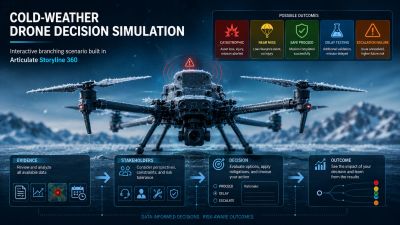
APEX DELIVERY FLEET SCENARIO
This project is a fully interactive branching scenario built in Articulate Storyline 360. It simulates a real‑world decision environment where a late‑shift operator must evaluate technical evidence, stakeholder input, and schedule pressure before authorizing a drone activation in unsafe cold‑weather conditions. The scenario is designed to assess decision‑making, evidence interpretation, and risk mitigation under stress.
Try the Storyline scenario by clicking the button below:
Context and Learning Goal
Organizations often face decisions where technical warnings conflict with commercial pressure. The scenario trains learners to interpret technical evidence, prioritize mitigations, and avoid deferring responsibility without transferring situational awareness.
What I delivered
- Realistic evidence artifacts (seal spec, test log, waiver).
- Stakeholder selection, mitigation checklist, and decision capture.
- JavaScript risk scoring and six outcome layers.
- Reflection and takeaway slides tying decisions to real‑world lessons.
Design Approach
- Learner persona: late‑shift operator with limited time and competing priorities.
- Evidence design: actionable artifacts that provide information needed to make a safe decision.
- Role‑based perspectives: simulate Engineer, CTO, and Safety Officer viewpoints to expose organizational constraints and trade‑offs.
- Decision mechanics: single decision with a short rationale, three potential mitigations, and a computed risk score driving six outcome layers.
Learning Outcomes and Assessment
- Measures whether learners act on evidence, apply mitigations, and communicate risk.
- Outcomes map to real consequences: catastrophic failure, near miss, safe proceed, delay for testing, and escalation failure.